

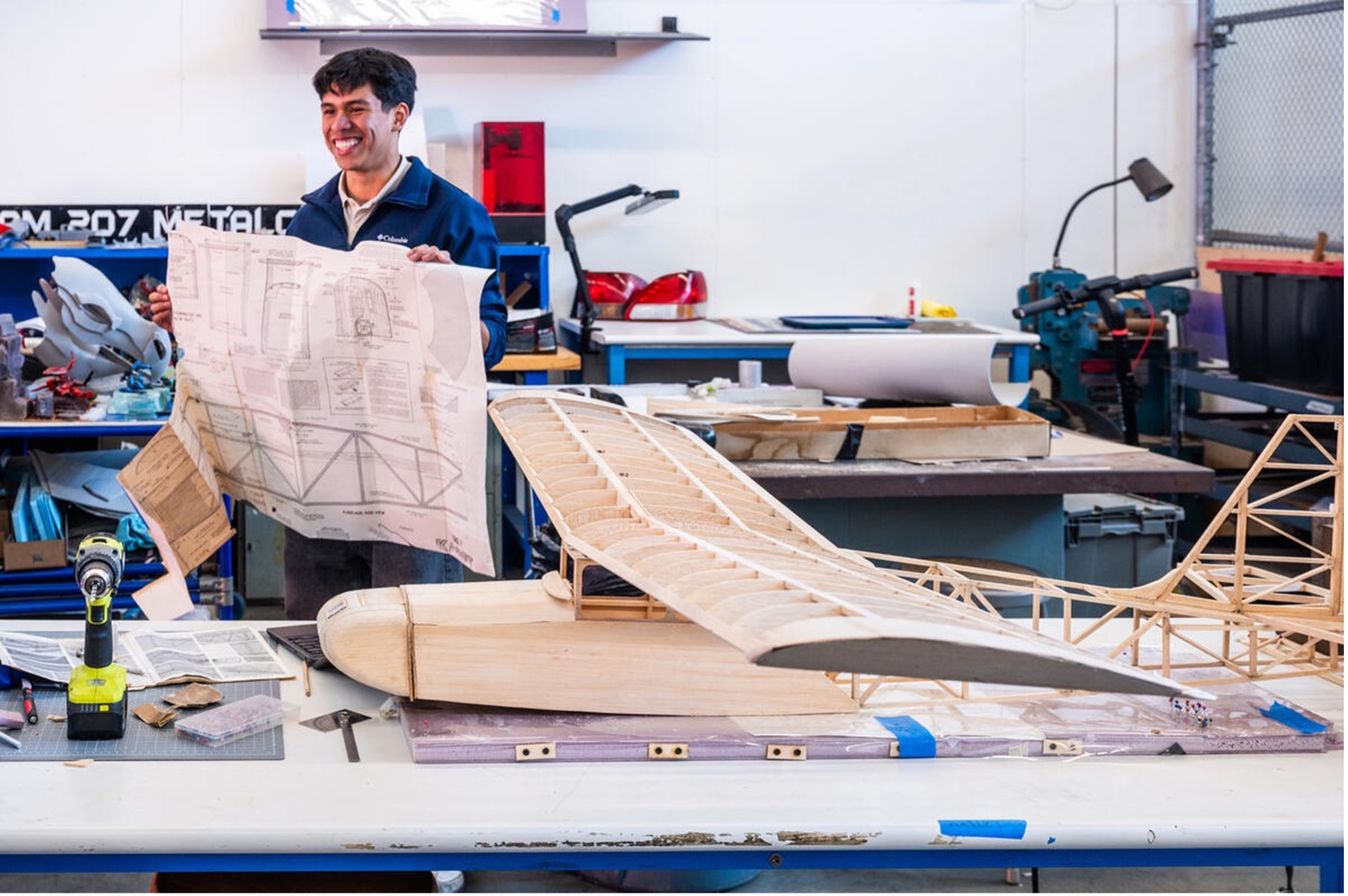
A model airplane sat on a table in an engineering lab at Hawthorne High School in California’s South Bay, a school I had the pleasure of visiting recently.
Two students, Victor Marin (left) and Ryan Broussard (right), built it.
I spoke with them about their plans after high school, and they shared how the plane project helped ignite their curiosity and how they are considering pursuing postsecondary degrees in engineering.
As they explained how they fabricated and assembled the parts, walking me through each step of the engineering process with the confidence that comes from doing, not just reading, it became clear this wasn’t simply a classroom assignment.
It was a glimpse of what education can look like when students can see how what they’re learning connects to the futures they want.
Moments like that should not be rare in American high schools; they should be the norm.
When Students Can See Their Future in the Classroom
Hawthorne High School serves about 1,600 students in grades 9–12 in the Centinela Valley Union High School District.
District Superintendent Dr. Stephen Nellman shared with me that students across the district can choose which high school they attend based on the programs and pathways that interest them most, giving them the agency to navigate toward futures aligned with their interests and goals.

Students at Hawthorne can explore three education pathways: Manufacturing and Engineering, Technical Arts and Design, and Wood Technology, each structured to help them build visible and transferable skills while connecting classroom learning to future college and career opportunities.
What makes this model distinctive isn’t just the courses students take. It’s the intentional design of the system around them.
In the Manufacturing and Engineering pathway, students begin with engineering fundamentals and progress into college-level coursework and hands-on learning experiences, including robotics, computer-integrated manufacturing tools, and 3D printers.
By senior year, they complete capstone projects, such as the airplane Victor and Ryan built, that require them to design solutions to real-world engineering challenges.
These students aren’t just choosing their own adventures; they’re participating in a clearly articulated pathway that serves as a bridge between high school, college, and career, helping students build momentum and navigate key transitions along the way.
Building Momentum Before Graduation
A key part of Hawthorne’s education pathways program is its partnership with El Camino College.
Through dual enrollment, students take college courses that are intentionally embedded within their high school pathways, earning credits that count toward both their high school diploma and career-connected postsecondary credentials. This design ensures that what students are learning in high school builds real momentum toward degrees and credentials of value.

In some cases, Hawthorne instructors teach the courses if they meet El Camino’s requirements. In others, El Camino faculty teach the classes directly.
In conversations with district and college leaders, one thing became clear: the partnership works because the focus stays on what benefits students most, not institutional turf.
Dr. Brenda Thames, President and CEO of El Camino College, explained that when students begin earning college credit while still in high school, something important happens. They start to see themselves as college students earlier and move toward their goals with greater confidence.
That confidence was echoed by students we met at the School of Engineering, who said they feel better prepared for the rigor of college and more certain about the options available to them after high school.
Connecting Learning to Real Opportunity
Classroom learning is only part of the pathway. Students also need opportunities to apply what they’ve learned and build skills that translate beyond the classroom.
Students gain workplace experience through internships with regional employers, including aerospace and manufacturing companies such as Boeing.
In the Centinela Valley Union High School District, these opportunities are made possible through close collaboration with the South Bay Workforce Investment Board, which plays a critical role in connecting schools with employers. It would be difficult for schools to build, sustain, and scale these relationships on their own.

But an employer-focused organization like the Workforce Investment Board helps coordinate partnerships and expand access to paid internships for students across the region.
These internships allow students to apply what they’re learning while developing the skills employers consistently say they need: communication, teamwork, problem-solving, and professionalism.
Just a few years ago, Hawthorne offered about 20 paid internships. Today, students have access to more than 160 paid placements with employers across South Bay.
That growth reflects not only strong school and employer engagement but also the essential coordinating role of the South Bay Workforce Investment Board in scaling opportunities that individual schools could not build on their own.
Michael Wiafe, Assistant Deputy Director of Workforce Policy at the California Workforce Development Board, emphasized that the level of trust among partners — schools, colleges, workforce organizations, and employers — is what allows them to solve problems quickly and expand opportunities for students.
Why This Matters Beyond One School
What’s happening in South Bay illustrates an important lesson for education leaders everywhere: strong education pathways don’t emerge from a single program.
They require coordinated systems that align schools, colleges, workforce partners, and employers around student success.

But models like this are still far too rare.
Nationwide, millions of young people graduate high school without a clear plan for what comes next or the support to navigate it.
That disconnect matters more than ever.
Within the next decade, about 85% of “good jobs”— those that lead to middle-class earnings — will require a bachelor’s degree or an industry-recognized credential, as noted by the Commission on Purposeful Pathways (and noted here).
Students themselves recognize this challenge. As noted in the Commission’s report (and noted here), 78 percent of Gen Z students say it’s important to determine career plans before graduating high school, but only 13 percent feel fully prepared to do so.
The issue isn’t ambition. It’s the absence of clear, connected education pathways that help students translate learning into opportunity.
Strong education pathways bring together rigorous coursework, advising, early college credit, career exploration, and real-world learning so students can see how their education leads to meaningful opportunities after graduation.
The Commission on Purposeful Pathways outlines a clear vision for bringing these elements together. Its framework calls for communities to offer coherent pathways that incorporate high-quality advising, accelerated coursework, and career-connected learning for every student.
These experiences are most effective when they intentionally cultivate purpose, belonging, and social capital, ensuring students graduate high school with credits banked, goals clarified, and networks formed, with real momentum toward economic mobility.
Building Systems Around Students
The work underway in South Bay reflects years of collaboration among schools, colleges, workforce organizations, and philanthropic partners.
This collaboration is part of the L.A. Purposeful Career Pathways Project, led by the California Community Foundation and UNITE-LA through the broader L.A. Region K–16 Collaborative.
Linda Collins, founder of the Career Ladders Project and a key partner in this initiative, emphasized that intermediary organizations play an important role in helping regions coordinate efforts, share lessons, and build stronger, better-connected data systems.

At the Gates Foundation, we support this work because we believe every student should have access to clear, affordable education pathways that lead to credentials and degrees of value in the workplace.
Efforts like what’s happening in South Bay are beginning to take shape in communities across the country.
We also support the Pathways Impact Fund, a national initiative led by StriveTogether and backed by several philanthropies. The Fund works with regional organizations, equipping them with funding, resources, and evidence-based supports to ensure more young people are on career-connected education pathways.
Policy Can Help These Models Reach Scale
Regional collaboration is essential. But supportive policy can help these efforts reach far more students.
California’s Golden State Pathways Program is a $500 million statewide initiative designed to strengthen partnerships among schools, colleges, employers, and workforce organizations.
The program supports dual enrollment, work-based learning, and stronger alignment between K–12 education and postsecondary programs so students can move more smoothly from high school into college and careers.
In the Centinela Valley Union High School District, funding from the Golden State Pathways Program has helped expand education pathways across the district, creating opportunities for more students to participate in programs that combine skill development, internships, and dual enrollment courses that lead to college credit.
Programs like this recognize that building strong education pathways, like what’s happening in South Bay, requires coordination across the entire education-to-workforce system and sustained public investment to support that coordination.
When Learning Takes Flight
That model airplane Victor and Ryan built is more than a classroom project. It’s a symbol of what becomes possible when students can connect learning with purpose.
Every high school student across the country should have access to career-connected education pathways that help them build skills, navigate choices, and move with momentum toward the futures they want.
Turning that vision into reality will require leadership and sustained commitment across education, workforce, and policy systems.
Lessons for Policymakers and Education Leaders
As outlined by the Commission on Purposeful Pathways, building systems that deliver these opportunities requires coordinated action across sectors to ensure every student has access to a coherent, high-quality pathway:
- Expand dual enrollment opportunities so students can earn college credit while still in high school.
- Align K–12, higher education, and workforce systems so education pathways lead clearly to credentials and careers.
- Support work-based learning partnerships with regional employers so students gain real workplace experience before graduation.
- Invest in cross-sector collaboration and regional intermediaries that help schools, colleges, and workforce partners coordinate and improve together.
- Provide sustained public funding that allows successful education pathways to scale.
These recommendations reflect a broader shift: moving beyond the high school diploma as the end goal and ensuring every student graduates with real momentum toward economic mobility.
When those elements come together, students graduate not just with a diploma, but with direction and confidence about what comes next.
And like the model airplane that sparked this reflection, the possibilities for their futures, and how far they can go, are limited only by how high they choose to soar.
Acknowledgments
I’m grateful to the many educators, students, and partners who took time to share their perspectives and experiences during my visit to South Bay.
Special thanks to my colleagues, Isa Ellis, Bill Tucker, and Sylvia Symonds from the Gates Foundation, for their leadership on our Pathways work.
I’m also thankful for the partnership and leadership of Dr. Stephen Nellman, Superintendent of the Centinela Valley Union High School District; Erik Hendricks, Principal of Hawthorne High School; and the educators and administrators helping bring these opportunities to life for students, including Sara Ott, Lucas Pacheco, and Hatha Parrish.
My thanks as well to the higher education partners in South Bay, including Dr. Brenda Thames and Maricela Sandoval from El Camino College.
This work is strengthened by the leadership of regional partners advancing education pathways across the South Bay and Los Angeles areas, including Jan Vogel and Janel Bullard from the South Bay Workforce Investment Board; Michael Wiafe from the California Workforce Development Board; Miguel Santana, Cielo Castro, Alba Bautista, and Jacqueline Amparo from the California Community Foundation; Alysia Bell, Carrie Lemmon, and Adam Gottlieb from UNITE-LA; and Linda Collins and Naomi Castro from the Career Ladders Project.
I’m also grateful for the insights of Olga Rodriguez from the Public Policy Institute of California.
Most of all, I want to thank the students, including Victor and Ryan, who shared their work and aspirations with me. Seeing their curiosity, creativity, and excitement about what they’re learning is the clearest reminder of why strengthening education pathways matters.