

When I met Jason this fall at Elliott Street Elementary School in Newark, NJ, I saw in him an illustration of both the challenge and the promise of education today.
Jason is an eighth grader who was once labeled a “behavioral challenge.” He struggled to stay focused in class, and like so many students, he had begun to internalize those low expectations.
But that’s not who Jason is anymore. Today, he’s thriving, a confident, outspoken student leader who loves math.
A big part of Jason’s transformation began in fourth grade when a teacher saw his potential and decided to try something new. She noticed that his behavior and motivation changed when he was able to work at his own pace by using Khan Academy with Khanmigo, an AI-powered tutor.
When using that tool, Jason was more engaged. He was challenged and supported in ways that resonated with him. With Khanmigo, Jason found something he hadn’t had before: a way to learn quickly or slow down, get help exactly when he needed it, and feel successful as he progressed from one session to the next and built momentum.
That changed everything.
“It (Khanmigo) feels like there’s an actual person sitting right next to you, teaching you things,” he said. “It’s like having a math teacher right there.”

Jason’s newfound excitement about learning was contagious. His face lit up even more when he talked about helping his younger sister, Camila, a third grader at the same school, with Khanmigo. He proudly guides her through math problems the same way he learned.
When Jason was helping his sister, he wasn’t just a student; he was a mentor, a big brother, and an example of what’s possible when the right teacher and tech-enabled supports are in place for students.
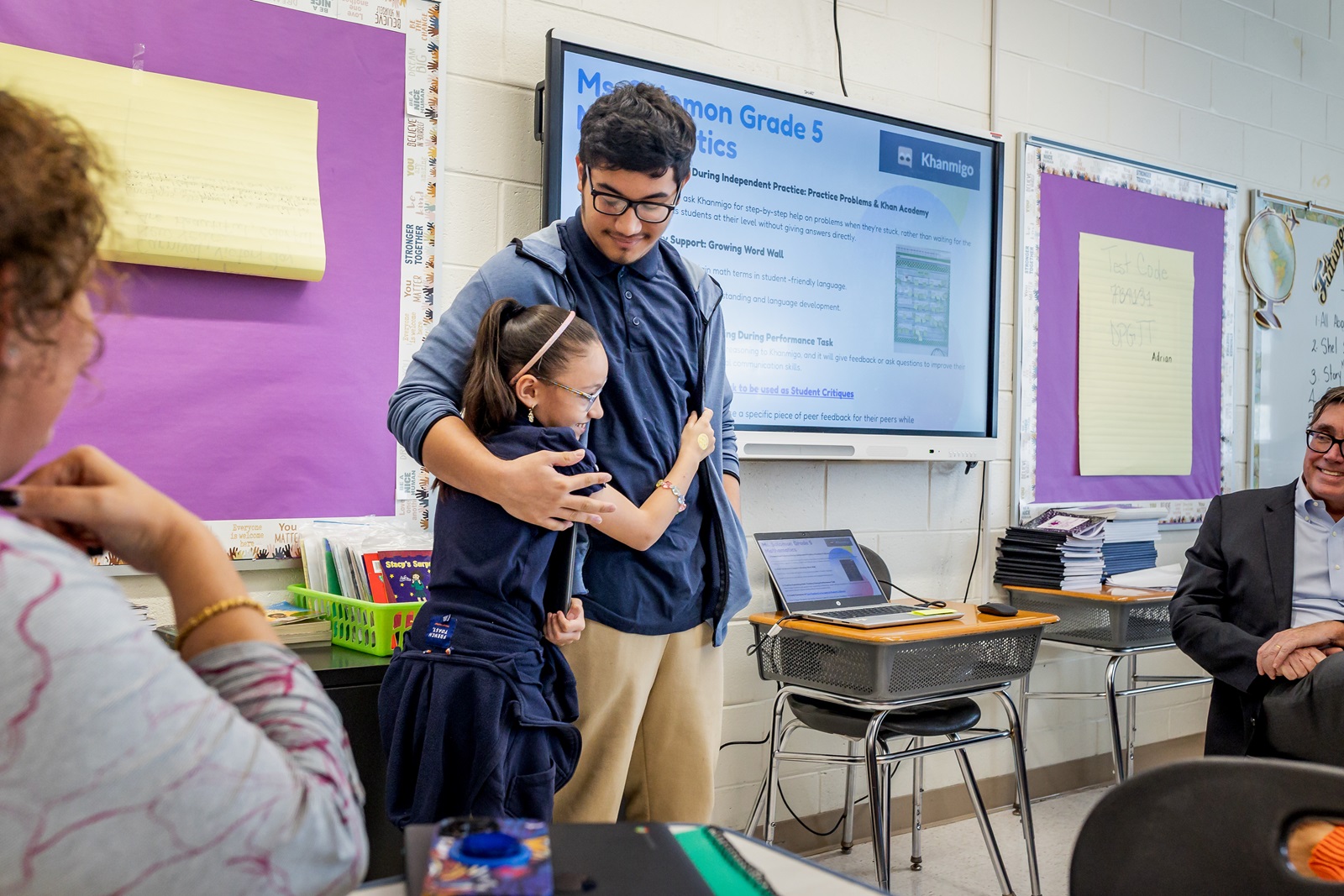
Jason’s story reminded me of my own. I was once considered disruptive in school until a teacher saw my potential and believed in me. For Jason, it was a combination of caring educators, supportive systems, and innovative tools that helped unlock his potential.
Jason’s Story is Part of a Larger Story
Elliott Street Elementary serves more than 800 students, most of whom qualify for free or reduced-price lunch. It might not be the first school you’d expect to be pioneering AI-driven instruction, but it’s doing just that.
Teachers across Elliott Street use Khanmigo as an integral part of reading, science, and math instruction. It’s not an add-on; it’s embedded in how they teach and how students learn.
The tool personalizes instruction in real time, detects student frustration, and supports students in the many languages spoken in the community, including English, Spanish, and Portuguese.
One Elliot Street teacher described Khanmigo as an "assistant." She said, “Not every student has the same resources at home. Some have relatives who’ve traveled the world and can bring learning to life. But for those who don’t, Khanmigo can offer a virtual version of that same richness. It’s a way to bring opportunity to every student, not just the lucky few.”
And it’s working.

In Newark’s North Ward, 68% of students have reached “efficacious usage” levels, meaning they engage with Khan Academy enough each week to achieve meaningful learning gains. Students who master just 10 new skills on the platform see, on average, a one-point increase on New Jersey’s state math test.
This is what happens when thoughtful innovation supports both teachers and students, when AI enhances, rather than replaces, the human connection at the heart of learning.
Our Commitment to Supporting Students and Teachers with Powerful New Technologies
Jason’s story also shows why the Gates Foundation is investing deeply in math education and in partnerships that bring high-quality, tech-enabled tools into classrooms.
Our focus on ensuring all students are taught using high-quality curriculum – and that teachers receive professional learning tied to that curriculum – is based on evidence of what works to improve student outcomes.
The emergence of AI and the ability for both teachers and students to engage with AI-enabled tools that provide feedback and actionable data has the potential to accelerate learning gains and reach far more students.
It’s part of our broader R&D effort, where we’re learning in real time what it takes to implement AI tools effectively in classrooms to support both teachers and students.
We will continue to build evidence of what works in pursuit of our K-12 goal of ensuring more students are proficient in algebra by no later than ninth grade – as doing so doubles the chances of graduating from high school and significantly increases the odds of completing college.
Of course, there’s still work to do.
We must ensure that every student, not just the lucky few, has access to these tools and the systems that make them effective.
If we get this right, stories like Jason’s won’t be the exception; they’ll be the expectation across the country.
Let’s work together to make that future real for every student in every classroom.